
Introduction
Omnichannel Marketing Strategy: Today’s customers rarely interact with a business through just one channel. They might discover a product on social media, visit the company’s website to compare options, read customer reviews, ask questions through WhatsApp, and eventually complete their purchase in an online store or physical location.
When these interactions feel disconnected, customers can become confused, frustrated, or less confident about making a purchase. For example, a customer might receive a promotional email for an item that is out of stock on the website, or they might need to repeat the same information when switching from live chat to customer support.
An omnichannel marketing strategy helps businesses address these challenges by connecting their marketing channels, customer interactions, and purchasing experiences. Instead of treating each channel as a separate activity, businesses create a coordinated journey that allows customers to move between channels with less friction.
This approach is important for businesses that want to improve customer satisfaction, build brand trust, increase conversions, and encourage repeat purchases. It also helps marketing teams deliver more relevant communications while maintaining a consistent brand identity.
In this guide, we will explore what omnichannel marketing means, how it differs from multichannel marketing, the key benefits of an integrated customer experience, and the practical steps businesses can follow to develop an effective strategy.
Suggested read: How AI-Powered Marketing Automation Is Changing Digital Campaign Management
What Is an Omnichannel Marketing Strategy?
An omnichannel marketing strategy is an integrated approach that connects a business’s marketing, sales, and customer service channels to create a consistent and coordinated customer experience.
These channels may include websites, mobile applications, email, social media, messaging platforms, physical stores, online marketplaces, and customer support systems.
The main objective is to make the customer journey feel connected, regardless of where an interaction begins or ends.
For example, imagine a customer discovers a skincare product through an Instagram advertisement. They visit the company’s website to explore the ingredients, subscribe to an email newsletter, and later contact the business through WhatsApp to ask about delivery. The customer then completes the purchase through the online store.
With an effective omnichannel marketing strategy, the product information, brand messaging, promotional terms, and support experience remain consistent throughout this journey.
A well-integrated experience can also allow the business to recognize relevant previous interactions, where the customer has given appropriate consent and the necessary systems support that capability.
The key principle is simple: customers should experience one connected brand, not a collection of unrelated marketing channels.
Omnichannel Marketing vs. Multichannel Marketing
Although the terms are sometimes used interchangeably, omnichannel and multichannel marketing describe different approaches to managing customer interactions.
Multichannel marketing means a business uses multiple channels to communicate with customers. These channels may operate independently, with separate campaigns, data, and performance goals.
Omnichannel marketing takes a more integrated approach by coordinating those channels around the customer journey.
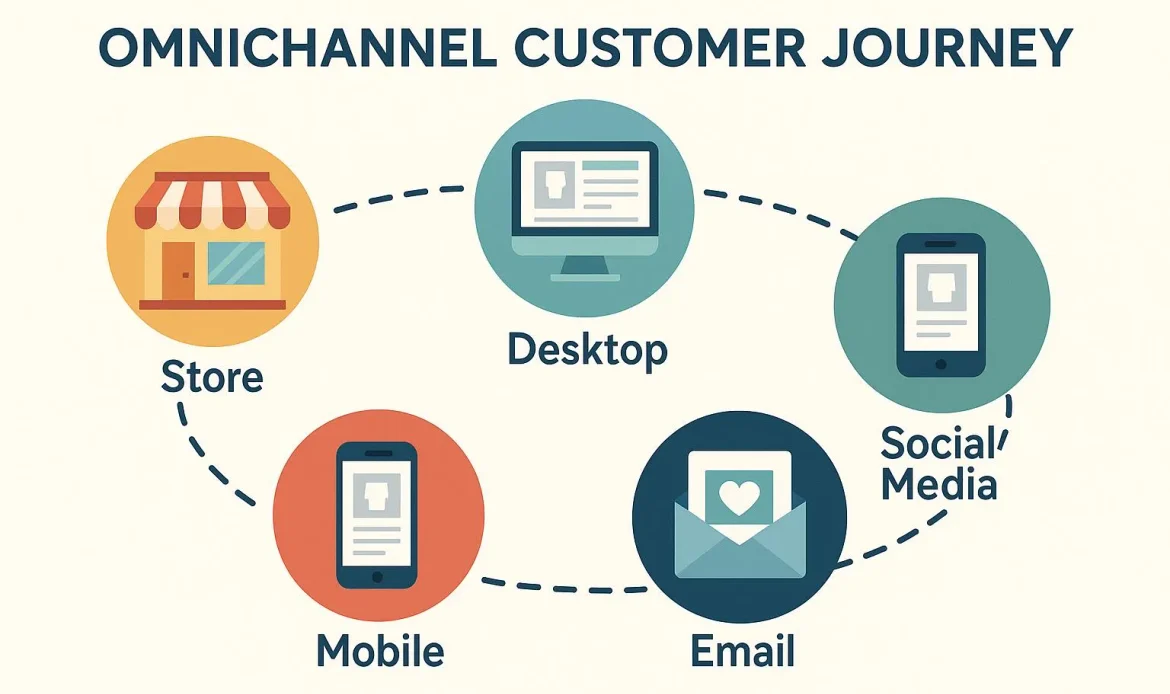
Here is a comparison of the two approaches.
| Feature | Multichannel Marketing | Omnichannel Marketing |
|---|---|---|
| Primary focus | Operating across multiple channels | Connecting the customer journey |
| Channel integration | May be limited | Coordinated across relevant channels |
| Customer data | Can be stored in separate systems | Shared or synchronized where appropriate |
| Brand messaging | May vary between channels | Consistent across touchpoints |
| Customer journey | Channels may operate independently | Designed around connected interactions |
| Personalization | Often channel-specific | Can use relevant cross-channel insights |
| Measurement | Individual channel performance | Channel performance and overall journey outcomes |
For example, a retailer might run separate promotions on Facebook, email, and its website. This is multichannel marketing if those activities operate independently.
If the retailer coordinates those campaigns, maintains consistent product information, recognizes customer preferences appropriately, and makes it easier for shoppers to move from an advertisement to a purchase, it is adopting an omnichannel approach.
Multichannel marketing can be an effective starting point for businesses with limited resources. Omnichannel marketing builds on that foundation by improving coordination and reducing friction between customer touchpoints.
Why Is Omnichannel Marketing Important?
Customers expect businesses to provide accurate information, convenient communication, and a reliable experience across the channels they use. An omnichannel marketing strategy helps businesses meet these expectations while making marketing activities more effective.
1. Creates a Consistent Brand Experience
Consistency helps customers recognize and trust a business. When the website, social media profiles, emails, advertisements, and customer support use consistent messaging, customers can better understand what the brand offers.
This includes more than visual branding. Product descriptions, pricing, promotional terms, return policies, delivery information, and customer service standards should also align across channels.
For example, if a business advertises free delivery on social media, customers should not discover unexpected delivery charges during checkout.
2. Improves Customer Engagement
Customers have different communication preferences. Some prefer email, while others use social media, messaging applications, or website chat.
An omnichannel approach allows businesses to meet customers on their preferred channels while keeping relevant interactions connected.
For example, a customer who discovers a service through LinkedIn might receive a relevant follow-up email after voluntarily subscribing to updates. This creates a more connected experience than sending unrelated promotional messages across multiple platforms.
3. Supports Higher Conversion Rates
Customers may need several interactions before making a purchase. They might compare prices, read reviews, ask questions, or wait for a suitable offer.
A coordinated customer journey can address these needs by providing relevant information at the right stage.
For example, an online store might help customers:
- Discover a product through a social media campaign.
- Explore its features on a detailed product page.
- Find answers through an FAQ section.
- Receive assistance through customer support.
- Complete checkout using a convenient payment method.
Removing unnecessary friction from these steps can improve the likelihood of conversion, although results depend on the product, audience, pricing, and overall customer experience.
4. Strengthens Customer Retention
An effective customer experience should continue after the first purchase. Customers may need order updates, product instructions, support, replacement information, or recommendations for related products.
Businesses can coordinate these interactions through email, SMS, messaging platforms, websites, and customer service systems.
For example, after a customer purchases a laptop, a retailer might send an order confirmation, provide shipping updates, share setup instructions, and offer relevant accessories later.
These communications should be useful, appropriately timed, and consistent with the customer’s preferences.
5. Provides Better Customer Insights
When marketing and sales systems are connected appropriately, businesses can develop a more complete understanding of customer behavior.
They may identify which channels introduce new customers, which interactions help people make purchasing decisions, and where potential buyers abandon the customer journey.
These insights can help businesses improve campaign targeting, website usability, product information, and customer support.
However, connecting customer data requires suitable access controls, data quality practices, and compliance with applicable privacy requirements.
Key Channels in an Omnichannel Marketing Strategy
An omnichannel strategy does not require a business to use every available platform. Instead, it should connect the channels that matter most to its audience and business objectives.
1. Website and Online Store
The website often serves as the central destination for product information, service details, lead generation, and online purchases. It should provide clear navigation, accurate information, mobile-friendly design, and a straightforward conversion process.
2. Social Media Marketing
Platforms such as Facebook, Instagram, TikTok, and LinkedIn help businesses build awareness, publish content, interact with audiences, and introduce products or services. Social media campaigns should direct users to relevant destinations with consistent offers and messaging.
3. Email Marketing
Email is useful for newsletters, lead nurturing, purchase confirmations, educational content, and customer retention. When integrated with customer preferences and purchase history appropriately, it can deliver more relevant communications.
4. Messaging and Customer Support
WhatsApp, website chat, messaging tools, and help desks can help customers ask questions and resolve issues. Connecting these channels to a suitable support process reduces the risk of repeated questions and conflicting answers.
5. Paid Advertising and Search
Search engine marketing, social media advertisements, and remarketing can introduce customers to a brand or bring them back to relevant pages. Campaigns should use consistent product information and respect advertising consent and platform policies.
6. Physical Stores and In-Person Sales
For businesses with physical locations, in-store experiences can complement digital marketing. Accurate inventory information, consistent pricing, convenient collection options, and coordinated customer service help connect online and offline interactions.
How to Create an Effective Omnichannel Marketing Strategy
Building a successful omnichannel strategy requires planning, collaboration, suitable technology, and ongoing measurement. The following steps provide a practical framework for businesses of different sizes.
Step 1: Understand Your Target Audience
Before integrating marketing channels, identify your customers, their needs, and the ways they prefer to interact with your business.
Useful research methods include customer surveys, interviews, website analytics, social media insights, sales records, and customer support feedback.
Consider questions such as:
- Which platforms do your customers use most frequently?
- How do they discover your products or services?
- What information do they need before making a purchase?
- Which factors prevent them from completing a transaction?
- Where do they prefer to receive customer support?
- What encourages them to return?
For example, a fashion retailer targeting younger shoppers may focus on Instagram, TikTok, mobile shopping, and messaging support. A B2B software company may prioritize search engines, LinkedIn, educational resources, email nurturing, and product demonstrations.
The goal is to select channels based on actual customer behavior rather than adopting every new marketing platform.
Step 2: Map the Customer Journey
Customer journey mapping helps businesses understand how people move from discovering a brand to purchasing and becoming repeat customers.
A typical customer journey includes five stages.
Awareness: Customer discovers the brand through social media, search results, advertisements, recommendations, or public relations.
Consideration: Customer compares products, reads reviews, explores the website, and evaluates available options.
Conversion: Customer places an order, books a service, or completes another desired action.
Retention: Customer receives useful follow-up communication, support, product guidance, or relevant service updates.
Advocacy: Satisfied customers may leave reviews, recommend the business, or share their experiences with others.
For each stage, document the channels customers use, the questions they ask, the problems they encounter, and the information they need.
Then identify gaps between channels. For example, if customers frequently move from Instagram to WhatsApp to ask about product prices, displaying clear prices on the product page may reduce unnecessary effort.
Step 3: Establish Consistent Brand Messaging
Brand consistency is a foundation of omnichannel marketing. Customers should receive the same essential information regardless of the platform they use.
Create clear brand guidelines covering:
- Logo usage, colors, typography, and visual identity.
- Brand voice, tone, and communication style.
- Product names, descriptions, specifications, and pricing.
- Promotional terms and campaign messaging.
- Customer service policies and frequently asked questions.
- Calls to action and preferred terminology.
This does not mean publishing identical content everywhere. Each channel has different formats and audience expectations.
A short video may be appropriate for TikTok, a detailed professional post may work better on LinkedIn, and a longer explanation may belong on a website blog.
The important point is that the format can change while the underlying message, offer, and brand identity remain consistent.
Step 4: Integrate Customer Data and Marketing Systems
Disconnected systems are a common obstacle to delivering a consistent customer experience.
A business might store website leads in one platform, email subscribers in another, purchase records in its e-commerce system, and support conversations in a separate help desk.
Without appropriate integration, teams may struggle to understand previous interactions or provide relevant follow-up.
Depending on business needs, useful technologies may include:
- Customer relationship management (CRM) software: Organizes customer profiles, leads, and sales interactions.
- Customer data platforms (CDPs): Help unify customer data from multiple sources for supported use cases.
- Marketing automation tools: Coordinate eligible email campaigns, workflows, and follow-up messages.
- Analytics platforms: Measure traffic, conversions, and customer behavior.
- Help desk systems: Organize customer questions, support history, and issue resolution.
- E-commerce integrations: Connect orders, product data, customer records, and post-purchase communications.
Start by identifying which data and workflows need to be connected. A small business may only need a website, CRM, email platform, and shared customer support process. Larger organizations may require more advanced integration.
Importantly, only collect and share customer information that is necessary for the intended purpose. Set appropriate permissions, protect sensitive data, and follow applicable privacy laws and consent requirements.
Step 5: Personalize Customer Interactions Responsibly
Personalization can make marketing more relevant by using appropriate information about a customer’s interests, previous purchases, preferences, or interactions.
For example, an online bookstore might recommend books related to a customer’s previous purchases. A software company might send educational resources relevant to a prospect’s selected product category.
Effective personalization should help customers rather than overwhelm them.
Businesses can improve personalization by:
- Segmenting audiences based on relevant characteristics.
- Sending content related to customer interests.
- Providing recommendations that match actual needs.
- Respecting communication preferences and opt-out requests.
- Avoiding excessive messaging and intrusive use of personal information.
- Keeping recommendations and offers accurate across channels.
Not every customer needs the same message. However, personalization should be based on reliable information and used transparently, with suitable consent and controls where required.
Step 6: Coordinate Campaigns Across Channels
An omnichannel campaign should feel like a connected sequence rather than a collection of unrelated promotions.
Suppose a company launches a new product. Its coordinated campaign might include:
- Publishing a product announcement on social media.
- Updating the website with accurate product information.
- Sending a relevant email to subscribers who are eligible to receive it.
- Running search and social advertising that directs customers to the correct landing page.
- Training customer support staff on product features and promotional terms.
- Providing order updates and post-purchase assistance to buyers.
Each activity supports the same campaign objective while serving a different role in the customer journey.
Campaign coordination also requires clear rules. For instance, customers who have already purchased a product should not continue receiving acquisition advertisements for that same purchase unnecessarily, where available tools allow suppression.
Step 7: Optimize the Mobile Customer Experience
Mobile devices play an important role in modern customer journeys. People often discover products through mobile advertisements, compare options on their phones, and contact businesses through messaging apps.
A disconnected or difficult mobile experience can undermine otherwise effective marketing.
To improve mobile usability:
- Use responsive website design.
- Optimize page loading speed.
- Make navigation and product information easy to understand.
- Minimize unnecessary checkout steps.
- Offer suitable payment and delivery options.
- Ensure buttons and forms work properly on small screens.
- Test links between advertisements, landing pages, and messaging platforms.
Businesses should test the complete journey on different devices rather than assuming that a mobile-friendly advertisement guarantees a mobile-friendly purchase experience.
Step 8: Align Marketing, Sales, and Customer Support Teams
Technology alone cannot create a consistent customer experience. Employees must also have accurate information and clear processes.
Marketing teams need to understand current offers. Sales teams should know what customers have already been promised. Customer support representatives need access to relevant order details and previous conversations where authorized.
To improve coordination, businesses can:
- Maintain a shared source of accurate product and policy information.
- Define responsibilities for campaign updates.
- Establish processes for escalating customer issues.
- Train employees on messaging and service standards.
- Review recurring complaints and customer feedback.
- Agree on shared performance goals.
For example, if a marketing campaign promises delivery within two days but the operations team cannot meet that timeline, the inconsistency can damage trust even if the advertisement performs well.
An effective omnichannel strategy therefore requires collaboration across the organization, not just within the marketing department.
Step 9: Measure Performance and Improve Continuously
An omnichannel strategy should be evaluated using both channel-specific metrics and overall customer journey outcomes.
A campaign may generate substantial website traffic but few purchases. A messaging campaign may produce many inquiries but limited sales. A retention campaign may generate fewer clicks while helping improve repeat purchases.
Businesses should assess the complete journey to understand what is working and where improvements are needed.
Track performance regularly, identify the most significant friction points, and test changes to messaging, landing pages, campaign timing, and customer support processes.
The best approach is continuous improvement rather than assuming that the initial strategy will remain effective indefinitely.
Real-World Omnichannel Marketing Examples
Businesses can apply omnichannel marketing principles in different ways depending on their products, customers, and operating models.
1. Retail and E-Commerce
A clothing retailer promotes a new collection through social media, displays matching products on its website, and sends relevant updates to opted-in customers. Shoppers can check product availability, contact support, and receive consistent order updates.
Main objective: improve product discovery and purchasing convenience.
2. Restaurants and Food Businesses
A restaurant shares its menu on social media, accepts orders through its website or supported delivery platforms, and provides consistent information about prices, opening hours, and promotions.
Main objective: reduce ordering friction and improve repeat visits.
3. B2B and Software Companies
A software company attracts prospects through search content, professional social media, webinars, and email. Sales representatives can use relevant CRM records to continue conversations without repeatedly requesting information the prospect has already provided.
Main objective: improve lead nurturing and sales coordination.
4. Beauty and Personal Care Brands
A personal care brand publishes educational content, displays product ingredients and usage instructions online, answers questions through customer support, and provides post-purchase guidance consistent with the product label.
Main objective: build customer confidence and encourage informed repeat purchases.
These examples illustrate possible implementations rather than guaranteed outcomes. Each business should adapt its channels and workflows to its customers and resources.
How to Measure Omnichannel Marketing Performance
Tracking the right key performance indicators (KPIs) helps businesses evaluate whether their omnichannel marketing strategy is improving the customer experience and delivering business results.
| KPI | What It Measures | Why It Matters |
|---|---|---|
| Conversion rate | Percentage of visitors or eligible users who complete a desired action | Evaluates how effectively the journey turns interest into action |
| Customer acquisition cost (CAC) | Cost of acquiring a new customer, based on a defined calculation | Helps assess acquisition efficiency |
| Customer lifetime value (CLV) | Estimated or measured value of a customer relationship over time | Supports retention and long-term growth decisions |
| Customer retention rate | Percentage of customers retained over a defined period | Indicates whether customers continue doing business with the company |
| Customer satisfaction (CSAT) | Customer-reported satisfaction with an interaction or experience | Highlights strengths and weaknesses in service delivery |
| Customer effort score (CES) | How easy customers report it was to complete a task | Helps identify unnecessary friction |
| Repeat purchase rate | Share of customers who purchase again within a defined period | Helps assess repeat business |
| Cart abandonment rate | Share of shopping carts that do not result in completed orders | Can reveal checkout and purchasing obstacles |
| Cross-channel conversion | Conversions involving interactions across multiple channels, based on defined tracking rules | Helps evaluate connected customer journeys |
Understand the Full Customer Journey
Do not evaluate omnichannel performance solely through likes, impressions, or individual campaign clicks. These metrics can provide useful context, but they do not necessarily show whether the customer experience is improving.
For example, a customer may discover a product through an Instagram advertisement, return directly to the website two days later, and purchase after receiving an email. If the business only measures the last interaction, it may overlook the role of the original advertisement.
Use suitable analytics, attribution methods, and conversion tracking to understand these interactions. Keep in mind that attribution models provide estimates rather than definitive proof that a particular channel caused a purchase.
Where possible, combine quantitative metrics with customer feedback, support records, and usability testing.
Common Omnichannel Marketing Challenges and How to Solve Them
Although an omnichannel strategy offers important benefits, implementation can be difficult without clear priorities and processes.
| Challenge | Practical Solution |
|---|---|
| Disconnected customer data | Integrate essential systems and establish consistent customer records |
| Inconsistent messaging | Maintain brand guidelines and a shared source of current product information |
| Limited budget | Start with the channels customers use most and expand gradually |
| Complex technology | Choose tools based on actual business needs and integration requirements |
| Poor team coordination | Define responsibilities, workflows, and shared performance goals |
| Inaccurate reporting | Standardize KPI definitions and review tracking quality |
| Privacy and consent risks | Apply data minimization, access controls, and appropriate consent practices |
| Excessive communication | Coordinate campaign schedules and respect customer preferences |
| Difficulty measuring results | Combine channel metrics with journey-level outcomes and customer feedback |
Avoid Trying to Integrate Everything at Once
A common mistake is attempting to connect every platform, automate every communication, and personalize every customer interaction in a single project.
This can increase costs, complicate workflows, and make it difficult to identify which improvements actually benefit customers.
A more practical approach is to identify the most important problem first. For one business, that may be inconsistent product information. For another, it may be disconnected customer support or a complicated checkout process.
Fix the highest-impact issues, measure the results, and expand the strategy as the business becomes more capable.
A Practical 90-Day Omnichannel Marketing Implementation Plan
Businesses that are new to omnichannel marketing can use a phased approach instead of investing in a large integration project immediately.
Days 1–30
Phase 1: Research and Audit
- Identify the main customer segments.
- Review existing marketing channels and customer touchpoints.
- Map the current customer journey.
- Find inconsistencies in pricing, messaging, support, or website usability.
- Establish baseline performance metrics.
Days 31–60
Phase 2: Integration and Coordination
- Standardize brand and product information.
- Connect priority systems where practical.
- Coordinate campaigns across selected channels.
- Improve mobile landing pages and conversion paths.
- Establish shared processes for customer support and sales.
Days 61–90
Phase 3: Testing and Optimization
- Measure results against the initial benchmarks.
- Review conversion rates and customer feedback.
- Identify friction points between channels.
- Test improvements to messaging and customer journeys.
- Prioritize the next set of improvements based on results.
The 90-day timeline is a planning framework, not a guarantee of completion. The actual schedule depends on the business’s size, available technology, data quality, and team resources.
Frequently Asked Questions About Omnichannel Marketing
1. What is the main goal of omnichannel marketing?
The main goal is to provide a connected, consistent, and convenient customer experience across relevant marketing, sales, and service channels. It helps customers move between touchpoints without unnecessary confusion or repeated effort.
2. What is the difference between omnichannel and multichannel marketing?
Multichannel marketing uses several communication channels, which may operate independently. Omnichannel marketing coordinates those channels around the customer journey to create a more integrated experience.
3. Is omnichannel marketing suitable for small businesses?
Yes. Small businesses can start by coordinating a few important channels, such as their website, social media, email, and messaging support. They do not necessarily need expensive enterprise software to improve consistency.
4. Which tools are needed for an omnichannel marketing strategy?
Common tools include a CRM system, email marketing software, analytics platforms, e-commerce integrations, marketing automation tools, and customer support software. The right combination depends on the business model, budget, and required integrations.
5. How does omnichannel marketing improve customer retention?
It helps businesses provide more relevant follow-up communication, consistent service, timely order updates, and easier access to support. These improvements can strengthen customer relationships and encourage repeat purchases.
6. How can a business measure omnichannel marketing success?
Businesses can track conversion rates, customer acquisition cost, retention, repeat purchases, customer satisfaction, customer effort, and cross-channel journey outcomes. Results should be compared with defined baselines and business objectives.
7. Does omnichannel marketing require customer data integration?
Not every business needs a fully unified data platform. However, connecting relevant customer records and operational information can reduce inconsistent messaging and help teams coordinate interactions. Any integration should follow suitable privacy, security, and consent practices.
8. How long does it take to implement an omnichannel strategy?
The timeline varies. A small business may coordinate a few channels within weeks, while a larger organization with legacy systems and multiple departments may require several months or longer. Implementation should be phased according to priorities and available resources.
Conclusion
An effective omnichannel marketing strategy is about more than maintaining a presence on multiple platforms. It is about connecting customer interactions to create a consistent experience from initial discovery through purchase, customer support, and long-term retention.
Businesses can build this experience by understanding their audiences, mapping customer journeys, maintaining consistent messaging, integrating relevant systems, personalizing communication responsibly, and aligning marketing, sales, and support teams.
Measuring performance across the complete customer journey is equally important. By combining business metrics with customer feedback, organizations can identify friction, make informed improvements, and allocate resources more effectively.
The best approach is to start with the channels that matter most to customers, solve the biggest experience problems first, and expand integration over time. With clear goals and continuous optimization, omnichannel marketing can become a valuable part of a sustainable customer experience strategy.