
Introduction
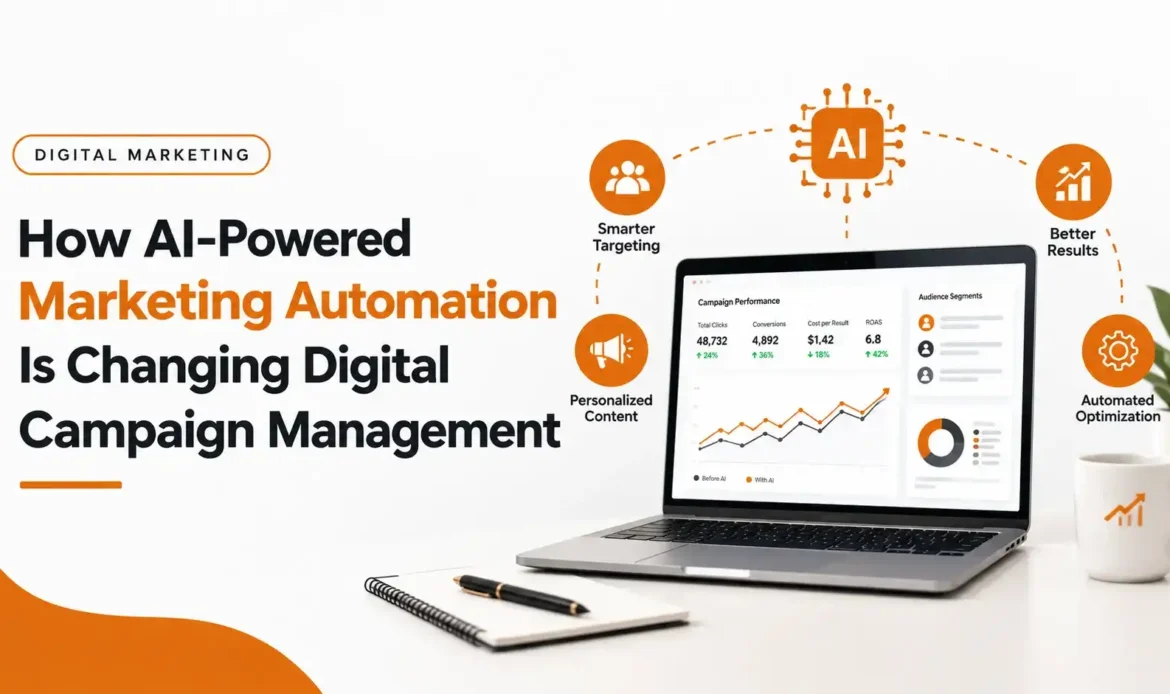
AI-Powered Marketing Automation Is Changing Digital Campaign Management: Digital marketing campaigns have become increasingly complex. Businesses must manage advertising platforms, email marketing, social media, website content, customer data, and performance reports while responding to changing customer expectations. Managing these activities manually can consume valuable time, slow down decision-making, and make it difficult to deliver consistent experiences across multiple channels.
AI-powered marketing automation is changing digital campaign management by combining artificial intelligence, customer data, predictive analytics, and automated workflows. Instead of relying only on fixed rules and manual performance reviews, marketers can use intelligent systems to identify patterns, personalize messages, streamline campaign execution, and make more informed optimization decisions.
Traditional automation typically follows predefined instructions. For example, a system may send a welcome email whenever someone subscribes to a newsletter. AI-powered automation can go further by helping determine which message is most relevant, when it should be delivered, and which customer segment is most likely to respond.
This shift is also changing how marketing teams approach their work. Research and industry analysis increasingly emphasize connected, AI-enabled workflows rather than using AI only for isolated tasks.
However, successful implementation still requires clear goals, reliable data, appropriate measurement, and human oversight.
In this article, we explore how AI-powered marketing automation works, its major applications, its benefits and challenges, and the practical steps businesses can take to improve digital campaign management.
Suggested read: Digital Media Marketing in 2026: Strategies for Reaching Customers Across Every Channel
1. What Is AI-Powered Marketing Automation?
AI-powered marketing automation is the use of artificial intelligence to analyze marketing data, support decisions, personalize customer interactions, and automate campaign activities across digital channels.
It combines traditional marketing automation with technologies such as machine learning, predictive analytics, natural language processing, and generative AI.
These technologies support different functions:
- Machine learning: Identifies patterns in campaign results and customer behavior.
- Predictive analytics: Estimates the likelihood of actions such as a purchase, subscription, or customer churn.
- Natural language processing: Helps systems interpret customer messages, reviews, search queries, and other language-based information.
- Generative AI: Assists with creating or adapting ad copy, emails, social posts, and other marketing content.
- AI-driven decision systems: Recommend or perform selected actions based on campaign objectives, available data, and configured rules.
AI marketing automation can connect website activity, customer relationship management (CRM) records, email engagement, advertising results, and purchase history to help marketers understand customer journeys and coordinate their campaigns.
Traditional automation vs. AI-powered automation
| Traditional marketing automation | AI-powered marketing automation |
|---|---|
| Primarily follows predefined rules | Can use patterns and predictions to inform decisions |
| Uses fixed audience segments | Can help identify more dynamic customer segments |
| Sends messages based on set triggers | Can recommend message timing and content |
| Relies heavily on manual analysis | Can summarize data and identify performance patterns |
| Uses scheduled or manually managed tests | Can support continuous testing and optimization |
| Requires people to configure most workflows | Can automate selected decisions within defined limits |
These approaches are not mutually exclusive. In practice, the most effective systems often combine reliable rule-based workflows with AI capabilities. Rules provide control and consistency, while AI helps interpret data and adapt selected actions.
2. How AI Is Transforming Digital Campaign Management
AI is influencing almost every stage of a digital campaign, from planning and audience research to content creation, execution, and performance evaluation.
2.1 Intelligent audience segmentation
Audience segmentation helps marketers divide potential customers into groups based on shared characteristics. Traditional segmentation often relies on broad categories such as age, location, interests, or previous purchases.
AI can help build more behavior-focused segments by analyzing available signals, including:
- Pages viewed and products explored
- Previous purchases and order frequency
- Email opens, clicks, and subscriptions
- Responses to different advertisements
- Interactions with customer support
- Recency and frequency of engagement
For example, an online store might identify separate groups of first-time visitors, repeat customers, shoppers who abandoned their carts, and customers who regularly purchase a particular product category.
Each group can receive a different message or customer journey. New visitors may see educational content, while returning customers may receive relevant product recommendations or information about complementary products.
AI-generated segments should be evaluated carefully. The quality of segmentation depends on the accuracy, relevance, and permitted use of the underlying data. A more complicated audience model is not automatically more profitable than a simple, well-designed segment.
2.2 Personalized marketing at scale
Customers encounter a large volume of promotional messages across digital channels. Generic campaigns can struggle to stand out when they fail to address the recipient’s interests or stage in the buying journey.
AI-powered personalization helps businesses adapt content, recommendations, and offers to different customer contexts. Depending on the platform and available data, a marketing system may recommend products, select relevant content, or tailor the next message in a customer journey. Salesforce, for example, documents AI-powered personalization capabilities that use machine learning to support recommendations and next-best-offer decisions.
Consider an online clothing store:
- A first-time visitor may receive content explaining the brand’s products and sizing.
- A customer who browses a specific collection may see relevant items in a follow-up message.
- A returning buyer may receive recommendations related to previous purchases.
- A customer who has not engaged recently may enter a re-engagement workflow.
The objective is not to personalize every word for every person. It is to make each interaction more relevant while respecting customer preferences, consent, and communication frequency.
2.3 Automated content creation and adaptation
Creating multiple campaign assets can be time-consuming. A single product launch may require search advertisements, social media captions, email sequences, landing page copy, and several creative variations.
Generative AI can help marketing teams develop first drafts, explore different messaging angles, adapt content for different platforms, and produce localized versions more quickly. Industry analysis identifies content variation, localization, creative testing, and production support as important opportunities for AI-assisted marketing workflows.
For example, a business promoting a new service could use AI to generate several versions of an advertisement:
- A benefit-focused version
- A version emphasizing convenience
- A version addressing a common customer question
- A version designed for returning visitors
Marketers can then review these options, check factual claims, confirm brand consistency, and test selected versions with real audiences.
AI-generated content still requires human review. Systems can produce inaccurate information, repetitive wording, generic creative concepts, or claims that are not supported by the business. Original insights, customer understanding, and brand judgment remain essential.
2.4 Real-time campaign optimization
Digital campaign performance changes as audience behavior, competition, creative fatigue, and market conditions evolve. A campaign that performs well at launch may become less efficient over time.
AI-supported optimization can analyze performance signals and recommend or execute selected adjustments, depending on the capabilities and settings of the platform. These may include changes to bids, audience allocation, creative combinations, or delivery strategies.
Google’s advertising guidance, for example, encourages advertisers to strengthen the data, creative, measurement, and performance foundations used by AI-powered advertising systems.
However, automated optimization does not guarantee improved business results. A platform may optimize for the objective it has been given, such as clicks or leads, rather than the revenue or profit a business ultimately needs. Marketers should verify that the optimization goal matches their actual business objective.
2.5 Predictive analytics and campaign planning
Predictive analytics uses historical and current data to estimate possible future outcomes. In digital campaign management, it can help teams prioritize audiences, anticipate demand, identify customers at risk of disengagement, and forecast campaign performance.
Potential applications include:
- Estimating which leads are more likely to convert
- Predicting demand for specific products
- Identifying customers who may stop purchasing
- Forecasting campaign spend and likely outcomes
- Detecting unusual changes in conversion rates
- Comparing possible budget allocation scenarios
These forecasts are estimates, not guarantees. Their reliability depends on data quality, model design, market stability, and whether the current campaign resembles the situations represented in the training data.
2.6 Automated cross-channel customer journeys
Customers rarely move through a simple, linear buying process. Someone might discover a brand through social media, visit its website through search, subscribe to email updates, and later make a purchase after seeing another advertisement.
AI-enabled marketing systems can help coordinate these interactions by connecting customer data and triggering workflows across channels. Marketing automation platforms increasingly support customer journeys that combine email, messaging, CRM data, and other marketing touchpoints.
A typical automated journey might work like this:
1. Customer discovers the brand
Search, social media, advertisement, or referral
2. Customer interacts
Website visit, product view, signup, or enquiry
3. System evaluates the available signals
Segment, engagement, preferences, and campaign context
4. Relevant follow-up is delivered
Email, permitted message, recommendation, or retargeting
5. Results are measured and refined
Conversions, revenue, engagement, and customer experience
The key advantage is coordination. Instead of treating every channel as a separate campaign, businesses can create a more consistent customer experience. They must still manage frequency caps, channel preferences, consent, and exclusions to avoid overwhelming customers with repeated messages.
3. Major Benefits of AI-Powered Marketing Automation
AI-powered marketing automation can improve campaign management when it is applied to well-defined problems and supported by appropriate data.
3.1 Greater operational efficiency
Marketing teams spend considerable time on repetitive tasks, including reporting, audience list preparation, campaign scheduling, content adaptation, and routine data checks.
Automation can reduce the amount of manual work involved in these activities. AI can further assist by summarizing performance, drafting content, identifying anomalies, and recommending next steps.
The practical benefit is not simply doing more work. It is giving marketers more time to focus on strategy, customer research, creative quality, and business growth.
3.2 Faster decision-making
Manual reporting can delay the discovery of campaign problems. AI-assisted analytics can help teams identify unusual changes, compare performance across segments, and surface potential explanations more quickly.
For instance, if a campaign generates many clicks but few sales, a marketing team can investigate the landing page, traffic quality, checkout process, pricing, and conversion tracking rather than immediately increasing the budget.
AI can help prioritize these checks, but marketers should verify the evidence before making substantial changes.
3.3 Improved customer experience
Relevant messages can make interactions more useful and reduce unnecessary promotional communication. AI can help businesses respond to customer interests, purchase history, and engagement patterns instead of sending identical messages to everyone.
A good customer experience also requires restraint. Excessive personalization, intrusive tracking, and frequent automated messages can damage trust, even when the underlying technology works as intended.
3.4 More efficient budget allocation
Campaign budgets are often spread across platforms, audiences, and creative formats. AI-based recommendations can help identify combinations that appear to perform more effectively against a chosen objective.
However, advertisers should not judge budget allocation only by low cost per click or cost per lead. A cheaper lead may be less likely to purchase, while a more expensive lead may generate higher long-term value.
Businesses should compare results using meaningful metrics such as qualified leads, customer acquisition cost, conversion rate, revenue, and return on advertising spend (ROAS), where appropriate.
3.5 More consistent testing
Testing different messages, landing pages, offers, and audience segments helps marketers learn what works. AI can assist with generating test variations, identifying patterns, and organizing the evaluation process.
Reliable testing still requires a clear hypothesis, appropriate sample sizes, and a defined success metric. Changing many campaign variables at once can make it difficult to determine which adjustment caused a performance change.
3.6 Better scalability
As businesses grow, manually managing campaigns across more products, locations, and audience segments becomes harder. Automated workflows can help maintain consistent processes while supporting more personalized communication.
Scalability depends on good governance. Businesses need clear permissions, quality checks, campaign naming conventions, documented workflows, and escalation procedures for unexpected outcomes.
4. How AI Is Changing Campaign Management Across Digital Channels
AI-powered automation does not operate in exactly the same way on every channel. Each platform has different data sources, capabilities, customer expectations, and performance metrics.
Paid advertising
AI can support bidding, creative variation, audience signals, budget recommendations, and performance analysis. Marketers should evaluate results against qualified conversions and business value rather than relying solely on platform-reported engagement.
Email marketing
AI can help tailor subject lines, recommend send times, segment subscribers, and coordinate triggered sequences. Consent, unsubscribe requests, deliverability, and message frequency remain essential.
Social media marketing
AI can assist with content planning, caption variations, sentiment analysis, scheduling, and reporting. Human review helps maintain a recognizable brand voice and prevents inappropriate or inaccurate posts.
E-commerce and websites
Recommendation systems can help display relevant products, personalize landing pages, and trigger follow-ups based on permitted browsing or purchase signals. Conversion tracking and a smooth checkout experience are equally important.
CRM and lead nurturing
AI can help prioritize leads, summarize interactions, recommend follow-up actions, and route enquiries to appropriate team members. Sales teams should be able to correct inaccurate classifications and review important decisions.
5. The Role of AI in Campaign Measurement and Performance Reporting
Campaign measurement is a critical part of digital marketing because businesses need to understand whether their investment is generating meaningful results.
Traditional reporting often presents metrics in separate dashboards. AI-assisted analytics can help connect these numbers, identify patterns, and explain where further investigation may be necessary.
For example, a campaign report may reveal the following:
| Metric | What it measures | What marketers should investigate |
|---|---|---|
| Impressions | How often ads are displayed | Reach, delivery, and audience size |
| Click-through rate (CTR) | Percentage of impressions generating clicks | Message relevance and creative quality |
| Cost per click (CPC) | Average cost for each click | Competition and traffic efficiency |
| Conversion rate | Percentage of relevant visits or clicks completing a defined action | Landing page quality, intent, and tracking |
| Cost per acquisition (CPA) | Cost of acquiring a defined conversion | Lead quality and customer acquisition economics |
| Return on ad spend (ROAS) | Attributed revenue relative to advertising spend | Revenue quality, attribution, and profitability |
| Customer lifetime value (CLV) | Estimated value generated by a customer over time | Retention, repeat purchases, and long-term economics |
AI can help identify combinations of metrics that deserve attention. A high CTR combined with a low conversion rate, for example, may indicate a mismatch between the advertisement and the landing page, although other explanations—including tracking problems—must also be considered.
Moving beyond vanity metrics
Impressions, likes, views, and clicks can be useful diagnostic indicators, but they do not always show whether a campaign is achieving its business objectives.
A lead-generation campaign should be evaluated on lead quality and the rate at which leads become customers. An e-commerce campaign should consider revenue, acquisition costs, returns, and margins. A brand-awareness campaign may require reach, frequency, recall, and other appropriate measures.
AI is most useful when it helps connect campaign activity to outcomes that matter to the business.
Understanding attribution and incrementality
Attribution models assign credit to marketing touchpoints that precede a conversion. They can help marketers understand customer journeys, but they do not necessarily prove that an advertisement caused a purchase.
Incrementality testing addresses a different question: did the campaign generate outcomes that would not otherwise have occurred? Controlled experiments, holdout groups, and other suitable measurement methods can help answer this question.
Google’s advertising guidance highlights measurement and experimentation as important parts of building effective AI-supported campaigns.
A strong measurement approach combines platform reporting with analytics, CRM or sales data, and experiments where feasible.
6. Popular Tools and Platforms for AI Marketing Automation
Businesses do not necessarily need a single platform that handles every marketing activity. The right combination depends on campaign objectives, technical requirements, budget, data maturity, and the team’s skills.
Useful for paid search and other advertising formats that offer AI-assisted campaign creation, bidding, delivery, and optimization features. Success depends on appropriate conversion measurement, creative assets, and campaign settings.
Salesforce Marketing Cloud
Supports connected customer journeys, cross-channel engagement, and AI-assisted marketing functions. It may suit organizations that need deeper integration with CRM and customer lifecycle processes.
HubSpot
Can support CRM-based marketing workflows, lead nurturing, email campaigns, and reporting. It may be useful for businesses that want to connect marketing activities with sales follow-up.
Mailchimp
Offers email marketing and automated customer communication workflows, with features that can support segmentation and campaign optimization. It can be a practical option for businesses focused on email and customer retention.
Adobe Marketo Engage
Designed for marketing automation and lead management, particularly in B2B environments with longer sales cycles and complex nurturing requirements.
Other tools specialize in social media management, customer analytics, content creation, or data integration. Features, pricing, availability, and AI capabilities vary by plan and can change over time, so businesses should confirm current product details before making a purchasing decision.
How to choose the right platform
Before adopting a new system, consider:
- Primary objective: Is the priority paid advertising, lead generation, customer retention, email marketing, or cross-channel coordination?
- Existing technology: Can the platform connect to the current website, CRM, analytics, and advertising accounts?
- Data quality: Are conversion events, customer records, and campaign parameters reliable?
- Control and approval: Can the team review generated content, restrict automated actions, and maintain an audit trail?
- Total cost: Do the subscription, implementation, integration, and ongoing management costs fit the budget?
- Measurable value: Can the business evaluate whether the platform improves meaningful outcomes compared with its current process?
7. Challenges and Risks of AI Marketing Automation
Although AI offers substantial opportunities, implementation comes with risks that businesses should address before giving automated systems greater responsibility.
7.1 Data privacy and consent
AI marketing systems may use customer behavior, purchase records, contact details, and other personal information. Collecting or processing such data without an appropriate legal basis, clear disclosure, or required consent can create legal and reputational risks.
Businesses should collect only necessary information, respect customer communication preferences, restrict access, and review the privacy requirements applicable to their markets.
7.2 Inaccurate or biased outputs
AI models can produce incorrect recommendations or systematically disadvantage certain groups when the underlying data or model design is flawed.
Teams should review consequential decisions, check for inconsistent results, and ensure that automated segmentation and targeting comply with applicable rules and company policies.
7.3 Generic or inaccurate content
AI-generated copy may sound repetitive, make unsupported claims, or fail to reflect the brand’s actual products and services. In regulated industries, incorrect claims can create additional compliance risks.
Human review should cover factual accuracy, tone, originality, brand suitability, and applicable advertising policies before content is published.
7.4 Overreliance on platform algorithms
Advertising platforms optimize around the goals and signals available to them. If conversion tracking is incomplete or the selected objective does not match business priorities, automated delivery may pursue outcomes that look promising in a dashboard but have limited commercial value.
Marketers should validate conversion tracking, compare platform results with first-party records, and assess lead quality and revenue wherever possible.
7.5 Integration and data-quality problems
Disconnected systems can produce duplicate records, missing conversion events, inconsistent campaign naming, and conflicting reports.
Before implementing sophisticated AI workflows, businesses should standardize data collection, document integrations, remove unnecessary duplication, and establish clear ownership for data quality.
7.6 Cost and skills requirements
AI tools can require subscriptions, technical setup, staff training, and ongoing evaluation. A sophisticated platform may add complexity without delivering enough value if a business has limited data or a small number of straightforward workflows.
A gradual implementation focused on high-value, repetitive tasks is often more practical than automating the entire marketing operation at once.
8. Best Practices for Implementing AI-Powered Marketing Automation
Successful AI adoption requires more than purchasing software. Businesses need a clear strategy that connects technology with customer needs and measurable marketing outcomes.
Step 1: Define measurable campaign objectives
Start by identifying the business result the campaign must achieve. Examples include increasing qualified leads, reducing customer acquisition cost, improving repeat purchases, or increasing profitable online sales.
Choose key performance indicators (KPIs) that reflect those goals. For example, a lead-generation campaign should measure qualified leads and sales conversion—not just the number of forms submitted.
Step 2: Audit existing marketing workflows
Review how campaigns are currently planned, launched, monitored, and reported. Identify repetitive tasks, recurring delays, common errors, and activities that consume time without adding much strategic value.
Prioritize workflows where automation can make a clear difference without creating unnecessary complexity.
Step 3: Improve tracking and data quality
Check that website analytics, conversion events, CRM records, advertising platforms, and sales systems capture relevant information accurately.
Establish consistent campaign naming, UTM parameters, conversion definitions, and reporting periods. AI recommendations are only as useful as the data and objectives informing them.
Step 4: Start with a focused use case
Choose one workflow to automate first. Suitable starting points include welcome emails, lead routing, campaign reporting, content variations, or identifying unusual performance changes.
A focused pilot makes it easier to compare results against the existing process, identify errors, and determine whether broader adoption is justified.
Step 5: Establish human approval and control
Decide which actions AI can perform independently and which require human approval.
For example, AI might draft ad copy or flag a campaign’s declining performance, while a marketer approves public claims, major budget increases, or changes that could significantly affect the brand.
Use spending limits, permission controls, testing environments, and clear escalation procedures where appropriate.
Step 6: Test performance systematically
Run controlled experiments where feasible. Change a limited number of variables, establish a primary success metric, and allow enough time and data for meaningful evaluation.
Compare automated workflows with the previous process and account for differences in seasonality, audience mix, offers, and measurement methods.
Step 7: Review, refine, and scale
Evaluate the pilot’s impact on performance, workload, customer experience, and operating costs. Document what worked and what did not.
Expand only after the team understands the workflow’s limitations and has a reliable process for monitoring its results.
9. A Practical 30-Day Implementation Plan
Businesses can use the following framework to begin introducing AI-powered marketing automation without attempting to overhaul every campaign at once.
Days 1–7
Audit and planning
- Define the main campaign objective.
- Review existing marketing tools and workflows.
- Audit conversion tracking and data quality.
- Select one suitable automation opportunity.
Days 8–14
Setup and configuration
- Configure the chosen platform or workflow.
- Connect the required data sources.
- Define rules, permissions, and approval steps.
- Test the process with sample data or a limited audience.
Days 15–21
Pilot campaign
- Launch the workflow on a controlled scale.
- Monitor delivery, engagement, conversions, and errors.
- Compare outcomes with a suitable baseline.
- Collect feedback from customers and team members.
Days 22–30
Evaluation and improvement
- Assess performance against the original objectives.
- Investigate unexpected outcomes.
- Refine the workflow and document lessons learned.
- Decide whether to continue, adjust, or expand the pilot.
This schedule is a starting framework, not a guarantee that every campaign can be evaluated conclusively within 30 days. Campaigns with low traffic, long sales cycles, or limited conversion data may require more time.
10. The Future of AI-Powered Digital Campaign Management
AI-powered marketing automation is moving beyond isolated tasks toward connected workflows that can coordinate research, content, targeting, campaign execution, and measurement.
Industry analysis increasingly describes this shift as a move toward continuous, AI-enabled marketing rather than a series of disconnected campaigns.
Several developments are likely to influence campaign management.
More autonomous marketing workflows
AI agents may increasingly handle sequences of tasks, such as reviewing campaign results, preparing proposed changes, generating content variations, and coordinating follow-up activities across connected systems.
The appropriate level of autonomy will vary by task. Routine reporting may require little intervention, while financial commitments, sensitive customer interactions, and significant brand decisions should retain stronger human controls.
More adaptive customer experiences
AI may help businesses respond more dynamically to customer interests, purchase history, and interaction context. The opportunity is to make communications more relevant across channels without relying exclusively on fixed customer journeys.
These capabilities will need to balance personalization with privacy, consent, and the customer’s expectations.
Stronger integration between data and execution
Campaign systems are likely to place greater emphasis on connecting customer data, analytics, content, and execution tools. Better integration can help reduce fragmented reporting and improve the consistency of campaign decisions.
However, integration alone does not ensure better marketing. Organizations still need shared definitions of success and reliable measurement across departments.
Greater emphasis on governance and accountability
As automated systems take on more responsibility, businesses will need clear policies governing data access, content review, permissions, spending, and performance monitoring.
Organizations that treat governance as part of implementation—not an afterthought—will be better positioned to use automation responsibly.
Ultimately, the competitive advantage will not come simply from using the most advanced AI tools. It will come from combining suitable technology with strong customer insight, effective creative work, reliable data, and sound decision-making.
Frequently Asked Questions (FAQs)
1. What is AI-powered marketing automation?
AI-powered marketing automation combines artificial intelligence with automated marketing workflows to analyze data, support campaign decisions, personalize customer interactions, and optimize selected activities across digital channels.
2. How does AI improve digital campaign management?
AI can help marketers identify audience patterns, create content variations, prioritize leads, analyze campaign performance, and automate routine tasks. Its impact depends on data quality, implementation, and how well campaign objectives are defined.
3. What are the main benefits of AI marketing automation?
The main benefits include reduced manual work, faster analysis, more relevant customer communication, improved testing processes, and better scalability. These benefits should be evaluated against measurable business outcomes rather than assumed.
4. Can AI fully manage digital marketing campaigns?
AI can automate or assist with many campaign activities, but fully autonomous management is not suitable for every business or task. Human oversight remains important for strategy, brand positioning, budget decisions, privacy, factual accuracy, and unexpected situations.
5. Which AI marketing automation tools should businesses use?
The right tool depends on the business’s needs. Google Ads supports advertising optimization, while platforms such as HubSpot, Salesforce Marketing Cloud, Mailchimp, and Adobe Marketo Engage address different CRM, customer engagement, email, and marketing automation requirements. Businesses should compare functionality, integration, pricing, and reporting before selecting a platform.
6. Is AI marketing automation suitable for small businesses?
Yes. Small businesses can start with focused applications such as email sequences, campaign reporting, content drafting, lead follow-up, and advertising analysis. Beginning with a simple workflow is often more practical than investing immediately in an extensive marketing technology stack.
7. How does AI personalize marketing campaigns?
AI can analyze permitted customer and campaign data to help identify interests, recommend products, adapt messages, and select relevant follow-up actions. Effective personalization requires accurate data, sensible communication frequency, and respect for customer privacy.
8. What are the biggest risks of AI marketing automation?
Important risks include inaccurate outputs, privacy violations, biased targeting, poor-quality data, overreliance on advertising algorithms, integration problems, and unexpected costs. Human review, appropriate access controls, and reliable measurement help reduce these risks.
9. How can businesses measure the ROI of AI marketing automation?
Businesses can compare relevant outcomes before and after implementation, including qualified conversions, acquisition cost, revenue, ROAS, retention, and time spent on manual tasks. Where possible, controlled experiments can help determine whether automation caused an improvement rather than simply coinciding with one.
10. Will AI replace digital marketing professionals?
AI is more likely to change the responsibilities of many marketing professionals than eliminate the need for marketing expertise altogether. Automation can handle parts of execution and analysis, while strategy, creativity, customer understanding, ethical judgment, and business accountability remain important.
Conclusion
AI-powered marketing automation is changing digital campaign management by making it possible to connect customer data, automate repetitive activities, personalize communication, and evaluate performance more efficiently. These capabilities can help businesses move from fragmented, manually managed campaigns toward more coordinated and responsive marketing operations.
However, technology alone does not guarantee better results. Poor tracking, unsuitable campaign objectives, unreliable data, and excessive automation can undermine performance just as easily as they can create efficiencies.
The most effective approach is to begin with clear business goals, strengthen measurement, choose a relevant use case, and test automation on a manageable scale. Businesses should retain human oversight for important decisions and expand successful workflows only when the evidence supports doing so.
The future of digital campaign management belongs to businesses that combine AI-driven efficiency with human creativity, reliable data, and a clear understanding of their customers.