
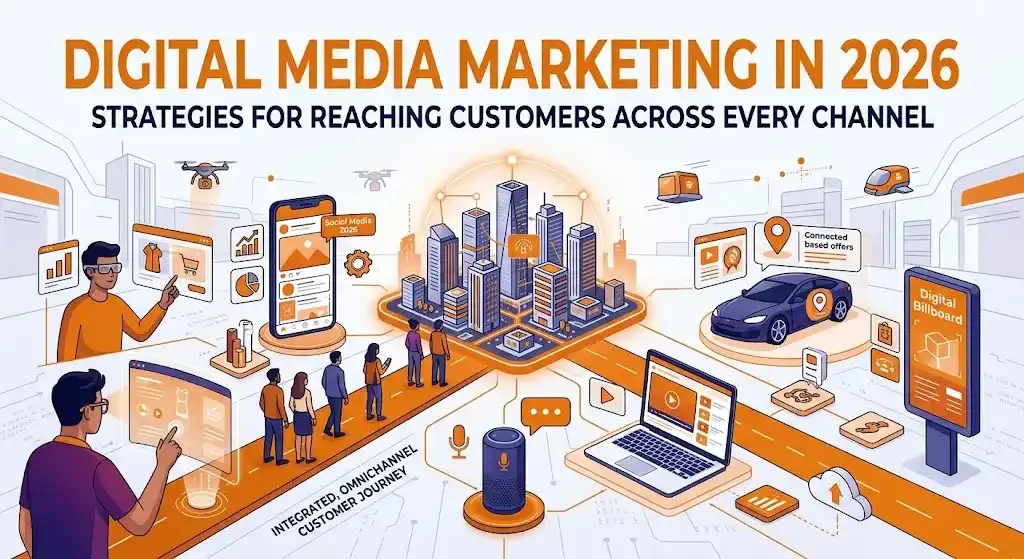
Digital Media Marketing in 2026: Digital media marketing has become an essential part of business growth in 2026. Customers discover brands through search engines, social media, online videos, digital advertisements, email newsletters, websites, review platforms, and AI-powered search experiences. They may first encounter a business through a short video, research its products on Google, compare reviews on social media, and finally make a purchase through its website.
This increasingly connected customer journey makes digital media marketing more complex than simply publishing content or running advertisements. Businesses need a coordinated strategy that connects every relevant channel, delivers consistent messaging, and measures how marketing activities contribute to meaningful results.
Artificial intelligence (AI), marketing automation, first-party customer data, personalized content, and cross-channel analytics are reshaping how organizations plan and execute campaigns. According to Gartner’s June 2026 marketing survey, digital media accounts for more than two-thirds of marketing media investment among the surveyed organizations, reflecting a continuing shift toward digital channels and customer acquisition. The survey also highlights the importance of investing in people, processes, and capabilities alongside AI technology.
For businesses, the opportunity is not to appear on every platform indiscriminately. It is to understand where their audiences spend time, determine which channels influence purchasing decisions, and build an integrated marketing system that attracts, converts, and retains customers.
This guide explores the most important digital media marketing strategies for 2026, explains how to connect different channels, and provides a practical framework for creating campaigns that support sustainable business growth.
What Is Digital Media Marketing?
Digital media marketing is the process of promoting a business, product, service, or brand through digital channels and online platforms. It combines communication, advertising, content distribution, audience targeting, customer engagement, and performance measurement to reach potential customers.
Unlike a campaign that depends on a single platform, digital media marketing can coordinate multiple channels throughout the customer journey.
For example, a business selling skincare products might use:
- Search engine optimization (SEO) to attract people searching for skincare advice.
- Social media marketing to demonstrate products and build a community.
- Paid advertising to reach relevant audiences and generate sales.
- Content marketing to answer customer questions and explain product benefits.
- Email marketing to nurture subscribers and encourage repeat purchases.
- Website optimization to turn interested visitors into customers.
- Analytics to understand which campaigns generate profitable results.
These channels serve different purposes, but they work more effectively when they support the same business objectives.
A successful digital media marketing strategy therefore combines audience research, channel selection, content planning, campaign execution, and ongoing optimization.
Why Digital Media Marketing Matters in 2026
Digital marketing is evolving as consumers change how they discover information, evaluate brands, and make purchasing decisions. Businesses must adapt their strategies to these behaviors rather than relying on outdated assumptions about how customers interact with advertising.
1. Customers use multiple channels before purchasing
A customer rarely follows the same path from awareness to purchase every time. Some people discover brands through social media, while others begin with a Google search, a recommendation, or an online review.
Research published by Boston Consulting Group in June 2026 emphasizes the growing importance of research-led consumer journeys and the need for brands to be discoverable, desirable, and trusted across relevant touchpoints.
Businesses that rely on only one channel may miss customers who use other platforms to compare options, verify credibility, or ask questions before making a decision.
An integrated strategy helps maintain visibility throughout this process.
2. AI is changing marketing operations
AI tools can help marketers research audiences, analyze campaign performance, create content drafts, identify patterns, and automate repetitive tasks.
However, adopting AI does not automatically improve marketing results. Businesses still need accurate data, appropriate workflows, quality control, and people who understand the audience and the commercial objectives.
Gartner’s 2026 research highlights that many marketing organizations still face challenges with AI readiness, internal expertise, and implementation maturity. This suggests that successful businesses should focus on practical applications rather than adopting tools simply because they are new.
3. Personalization helps make campaigns more relevant
Customers receive a large volume of promotional messages every day. Generic advertisements and repetitive emails can easily be ignored.
Personalization allows businesses to adapt their communication according to customer interests, previous interactions, preferences, and stage in the purchasing journey.
For example, a visitor who reads an article about business website development may respond better to a relevant case study or website audit offer than to an unrelated promotion.
Effective personalization should be useful, proportionate, and respectful of customer privacy. It should not rely on intrusive tracking or assumptions that the business cannot justify.
4. Marketing performance is increasingly measurable
Digital platforms provide data about impressions, clicks, visits, leads, purchases, and other actions. These insights help marketers identify which campaigns are performing well and where improvements are needed.
However, measuring individual channels separately can create an incomplete picture. A social media campaign may introduce a customer to a brand, while a later search advertisement or email encourages the purchase.
Businesses should therefore combine channel-level reporting with broader measures of customer acquisition cost, conversion rate, revenue, and customer lifetime value.
5. Owned audiences are becoming more valuable
A social media following can be useful, but a business does not control the platform, its algorithms, or its distribution policies.
A website, an opted-in email list, a customer relationship management (CRM) system, and permission-based customer records provide greater control over ongoing communication.
A balanced strategy uses external platforms to attract audiences while building direct relationships through channels the business can manage more reliably.
The Main Digital Media Marketing Channels in 2026
An effective digital media strategy combines channels according to their strengths. Some generate awareness, others capture existing demand, and others help convert interested prospects into customers.
The following channels form the foundation of a modern digital media marketing plan.
1. Search Engine Optimization (SEO)
SEO helps websites attract organic traffic from search engines. It includes technical optimization, useful content, internal linking, website performance, and the development of trust and authority.
In 2026, SEO strategies should also account for AI-powered search experiences, which can provide summaries and recommendations directly within search interfaces.
Businesses should focus on answering genuine customer questions, publishing accurate information, demonstrating first-hand expertise, and maintaining a technically sound website. Search visibility can also depend on how clearly a business explains its products, services, location, and expertise.
For example, a web development agency could publish guides about website costs, platform comparisons, website security, and conversion optimization. These resources can attract people researching solutions before they are ready to contact an agency.
Best uses: Long-term organic visibility, educational content discovery, high-intent traffic, and building credibility.
2. Paid Search Advertising
Paid search campaigns help businesses reach people who are actively searching for specific products or services. Platforms such as Google Ads allow advertisers to target relevant search queries, locations, and audiences.
A company providing accounting software, for example, could advertise for relevant searches related to accounting systems, inventory software, or business reporting tools.
Successful paid search campaigns require more than selecting keywords. Advertisers need relevant landing pages, accurate conversion tracking, clear offers, and regular reviews of search terms and lead quality.
Automated bidding and AI-assisted campaign features can help optimize delivery, but businesses should monitor performance against actual business outcomes rather than clicks alone.
Best uses: Capturing existing demand, generating qualified leads, promoting time-sensitive offers, and supporting product sales.
3. Social Media Marketing
Social media platforms provide opportunities to introduce brands, distribute content, build communities, and interact directly with customers.
The best platform depends on the audience and business model. LinkedIn may be valuable for B2B services, Instagram and TikTok may suit visual products, and YouTube can support demonstrations, education, reviews, and long-form explanations.
Rather than publishing identical content everywhere, businesses should adapt their messages to each platform. A detailed article can become a LinkedIn post, a short educational video, a carousel, and a series of frequently asked questions.
Social media success should be measured through relevant outcomes such as qualified website visits, enquiries, purchases, saves, meaningful engagement, and customer retention.
Best uses: Brand awareness, community building, customer interaction, creator partnerships, and visual storytelling.
4. Content Marketing
Content marketing attracts and educates audiences through valuable information rather than relying exclusively on direct promotional messages.
Common formats include blog articles, case studies, research reports, videos, webinars, guides, podcasts, and downloadable resources.
Strong content should address the questions customers ask before making a decision. A business selling project management software could create content about workflow problems, software comparisons, implementation costs, and productivity measurement.
Content can also support other marketing channels. Blog articles provide material for social media, email newsletters, sales presentations, and paid campaign landing pages.
Best uses: Education, demand generation, brand authority, organic discovery, and supporting sales conversations.
5. Email Marketing
Email marketing gives businesses a direct way to communicate with people who have subscribed or otherwise provided appropriate permission.
It can support welcome sequences, educational newsletters, product announcements, abandoned-cart reminders, customer onboarding, and repeat-purchase campaigns.
A well-planned email strategy divides subscribers into meaningful groups based on preferences, purchase history, or engagement. It then sends relevant messages rather than repeatedly sending the same promotion to everyone.
Businesses should also manage consent, unsubscribe requests, authentication, deliverability, and data security.
Best uses: Lead nurturing, customer retention, personalized communication, and repeat sales.
6. Display and Video Advertising
Display and video advertisements help businesses reach audiences beyond active searchers. They can introduce products, explain complex services, reinforce brand recognition, and support remarketing where permitted.
Video is particularly useful for demonstrating how a product works or showing the customer experience. Display advertising can support awareness and help maintain visibility among relevant audiences.
However, impressions and video views do not necessarily translate into sales. Campaigns should have clear objectives and be evaluated using appropriate indicators, including reach, qualified visits, conversions, and incremental results where measurable.
Best uses: Awareness, product demonstrations, brand recall, and audience re-engagement.
7. Influencer and Creator Marketing
Creators can help businesses reach established communities through content that fits the audience’s interests.
The most appropriate partner is not always the creator with the largest following. Audience relevance, trust, content quality, engagement authenticity, and alignment with the brand can be more important than follower count.
Businesses should establish clear deliverables, usage rights, disclosure requirements, timelines, and performance measures before launching a collaboration.
Creator content may also be repurposed for a website, social media campaign, or paid advertisement when the agreement allows it.
Best uses: Trust building, product discovery, demonstrations, community reach, and user-generated content.
8. Website and Conversion Rate Optimization
A website is often the central destination connecting all digital marketing channels. Even strong advertising campaigns can underperform if the website is slow, confusing, difficult to navigate, or unclear about the next step.
Conversion rate optimization (CRO) improves the likelihood that visitors will complete meaningful actions, such as submitting an enquiry, booking a consultation, registering for a webinar, or purchasing a product.
Businesses can improve conversions by testing headlines, calls to action, page layouts, forms, pricing information, testimonials, and checkout processes.
Changes should be evaluated using reliable data rather than assumptions about what looks better.
Best uses: Lead generation, online sales, campaign landing pages, and improving returns from existing traffic.
9. Messaging and Customer Communication
Messaging channels such as WhatsApp, website chat, and business messaging tools can help customers ask questions, receive support, and move toward a purchase.
For businesses where customers need guidance before buying, quick and accurate responses can reduce uncertainty and improve the buying experience.
Messaging should be integrated with customer service processes, lead management, and follow-up procedures. Automated responses can handle routine questions, but complex enquiries should have a clear path to a human representative.
Businesses should avoid unsolicited bulk messaging and respect platform rules and customer preferences.
Best uses: Customer enquiries, sales assistance, appointment coordination, and post-purchase support.
10. Online Reviews and Reputation Management
Reviews influence how prospective customers evaluate businesses, particularly when choosing local services, software, agencies, healthcare providers, or high-value products.
A reputation strategy should encourage genuine feedback, monitor customer concerns, respond professionally, and use recurring complaints to improve service quality.
Businesses must not manufacture reviews or offer misleading incentives. Honest reviews and transparent responses help establish credibility.
Best uses: Trust building, local discovery, purchase confidence, and improving customer experience.
How to Build an Integrated Digital Media Marketing Strategy
Using several marketing channels does not automatically create an integrated strategy. Integration requires a shared objective, consistent messaging, coordinated customer experiences, and reliable measurement.
The following framework helps businesses build a practical strategy.
Step 1: Define measurable business objectives
Start by identifying what the business needs to achieve. Common objectives include:
- Increasing qualified website traffic.
- Generating sales enquiries or consultation bookings.
- Improving online sales and revenue.
- Increasing brand awareness in a specific market.
- Reducing customer acquisition costs.
- Improving repeat purchases and customer retention.
Each objective should have a measurable indicator and a defined time period.
For example, a B2B service company might aim to increase qualified enquiries by 20% over three months. This goal is more useful than simply aiming to increase social media followers because it connects marketing activity to a business outcome.
Step 2: Research your target audience
Effective campaigns begin with understanding the people they are intended to reach.
Research should identify customer needs, common problems, buying motivations, objections, budget considerations, and preferred communication channels.
Useful research methods include customer interviews, sales-team feedback, website analytics, search-query analysis, surveys, customer reviews, and CRM records.
Create practical audience segments based on meaningful differences. A software company might distinguish between small businesses seeking affordable tools and larger organizations requiring advanced integrations.
Avoid creating overly detailed personas based on unsupported assumptions. Audience research should reflect real customer behavior whenever possible.
Step 3: Select the right channel mix
Businesses do not need to invest equally in every platform. Channel selection should reflect audience behavior, business goals, available resources, competition, and the time needed to achieve results.
| Business objective | Channels to consider | Primary metric |
|---|---|---|
| Improve organic discovery | SEO and content marketing | Qualified organic visits |
| Generate immediate leads | Paid search and landing pages | Cost per qualified lead |
| Build brand awareness | Social media and video advertising | Reach and brand lift |
| Nurture prospects | Email and educational content | Qualified conversions |
| Increase online sales | SEO, paid ads, CRO, email | Revenue and conversion rate |
| Improve retention | Email, messaging, customer support | Repeat purchase and retention rate |
These are starting points, not universal rules. A B2B business may rely heavily on search, LinkedIn, email, and webinars, while a consumer brand may prioritize short-form video, creators, shopping features, and lifecycle messaging.
Step 4: Create a consistent brand message
A customer may encounter a business across several channels in a short period. Conflicting claims, different offers, or inconsistent visual branding can create confusion.
Develop a central messaging framework that defines the brand promise, target audience, main benefits, supporting evidence, tone of voice, and calls to action.
Adapt the presentation to each platform without changing the underlying message.
For example, a campaign promoting website development could use:
- A short social video explaining a common website problem.
- A blog article comparing website development options.
- A search advertisement targeting people seeking a development agency.
- An email sharing a relevant case study.
- A landing page explaining the service and offering a consultation.
Each asset serves a different purpose while supporting the same campaign.
Step 5: Coordinate campaigns across channels
Cross-channel marketing works best when campaigns share a calendar, common objectives, consistent offers, and clearly defined responsibilities.
A simple campaign plan should identify the audience, key message, content assets, launch dates, channel owners, budget, conversion goal, and reporting requirements.
Use campaign naming conventions and tracking parameters consistently. This makes it easier to understand which activities generate visits and conversions.
Google Analytics provides traffic-source reporting and attribution tools that help businesses evaluate how channels contribute to important actions. Its reporting options include data-driven attribution and paid-and-organic last-click attribution, subject to the available configuration. Google Analytics attribution documentation.
Step 6: Test, learn, and improve
Digital media marketing should operate as a continuous improvement process.
Test one meaningful variable at a time when possible, such as the landing-page headline, creative format, audience segment, offer, or call to action.
Allow tests enough time and traffic to produce interpretable results. Avoid declaring a winner based on a handful of clicks or short-term fluctuations.
Use the findings to refine the next campaign, and document what worked, what failed, and what remains uncertain.
The Role of AI in Digital Media Marketing in 2026
AI is increasingly used throughout the marketing workflow. Its value comes from helping teams analyze information, reduce repetitive work, and adapt content and campaigns more efficiently.
AI-assisted content creation
Generative AI can help produce outlines, initial drafts, campaign variations, summaries, and content repurposing ideas. Human review remains essential for factual accuracy, originality, tone, and strategic relevance.
Businesses should not publish large volumes of generic AI-generated content simply to increase output. Content still needs to answer real customer questions and offer meaningful value.
Predictive analysis and audience segmentation
Machine-learning systems can help identify patterns in campaign performance, estimate the likelihood of conversion, and group customers according to behavior.
These insights can inform budget allocation and messaging, but the quality of the results depends on the quality of the data and the suitability of the model.
Marketing automation
Automation can coordinate email sequences, lead routing, reporting, and routine follow-ups. More advanced AI agents may support multi-step workflows, although businesses should carefully define their permissions, escalation rules, and oversight.
Gartner has forecast that 60% of brands will use agentic AI to facilitate streamlined one-to-one interactions by 2028. This is a prediction, not a claim that all brands already use such systems in 2026.
AI-powered campaign optimization
Advertising platforms can automate bidding, audience expansion, and creative delivery. These capabilities can save time, but marketers should continue reviewing budget distribution, lead quality, customer experience, and profitability.
The best approach is to use AI where it offers a clear advantage, maintain human accountability, and measure its actual impact.
First-Party Data and Privacy-Conscious Marketing
First-party data is information a business collects directly through its own customer relationships and digital properties, subject to applicable consent and privacy requirements.
Examples include customer purchases, voluntarily submitted forms, subscription preferences, website interactions, and service enquiries.
This information can help businesses understand customer needs, personalize communication, and evaluate campaign performance.
A practical first-party data strategy should include:
- Clear collection purposes: Explain why information is needed and how it will be used.
- Appropriate consent: Obtain permission where required and respect communication preferences.
- Data quality: Keep records accurate, relevant, and up to date.
- Secure storage: Limit access and protect sensitive customer information.
- Useful segmentation: Group audiences according to relevant preferences or behavior.
- Retention rules: Avoid keeping personal information longer than necessary.
A CRM can help consolidate customer interactions, but it should not become a repository for unnecessary data. Businesses should collect what they need, protect it appropriately, and use it responsibly.
How to Measure Digital Media Marketing Performance
An integrated marketing strategy needs a measurement system that connects activity to outcomes.
The right metrics depend on the campaign objective. A brand-awareness campaign should not be judged solely by immediate sales, just as a sales campaign should not be considered successful merely because it generated many impressions.
Important digital marketing KPIs
| Metric | What it measures | When it is useful |
|---|---|---|
| Reach | Number of unique people exposed to content or ads | Awareness campaigns |
| Click-through rate (CTR) | Percentage of impressions that result in clicks | Evaluating ad or content relevance |
| Conversion rate | Percentage of visitors completing a desired action | Landing pages and sales funnels |
| Cost per lead (CPL) | Marketing cost per generated lead | Lead-generation campaigns |
| Customer acquisition cost (CAC) | Cost of acquiring a customer | Assessing acquisition efficiency |
| Return on ad spend (ROAS) | Attributed revenue divided by advertising spend | Evaluating paid advertising |
| Customer lifetime value (CLV) | Estimated value of a customer over the relationship | Retention and long-term profitability |
| Retention rate | Share of customers retained over a defined period | Loyalty and repeat business |
Understanding return on ad spend
ROAS can be calculated using the following formula:
[
\text{ROAS}=\frac{\text{Revenue attributed to ads}}{\text{Advertising spend}}
]
For example, if an advertising campaign generates PKR 500,000 in attributed revenue from PKR 100,000 in ad spend, its ROAS is 5:1.
That does not automatically mean the campaign is profitable. Product costs, salaries, agency fees, shipping, returns, and other expenses may need to be considered. Attributed revenue is also not necessarily incremental revenue: some customers might have purchased without seeing the advertisement.
Measure the complete customer journey
A cross-channel report should bring together relevant information from website analytics, advertising platforms, CRM records, and sales systems.
Google Analytics supports cross-channel conversion reporting and attribution paths, helping marketers examine how paid and organic channels contribute to important actions. The availability of some reporting features may vary by property.
Where practical, businesses should also use controlled experiments or incrementality testing to determine whether campaigns produce additional results rather than merely receiving credit for conversions that would have happened anyway.
Common Digital Media Marketing Mistakes to Avoid
Even a business with a substantial marketing budget can underperform if its strategy lacks coordination.
Being present on every platform
Managing too many channels can spread resources thinly and reduce content quality. Start with the channels most relevant to the target audience and expand when the team can manage them effectively.
Publishing the same content everywhere
Different platforms have different formats, expectations, and user behaviors. Repurpose ideas, but adapt the creative, length, message, and call to action.
Focusing on vanity metrics
Followers, impressions, and likes can provide useful context, but they do not always demonstrate business value. Connect reporting to qualified leads, sales, customer retention, and profitability.
Depending entirely on paid advertising
Paid campaigns can generate immediate visibility, but costs and competition can change. Build complementary assets such as a strong website, helpful content, organic search visibility, and an opted-in email audience.
Using AI without quality control
AI-generated information may be inaccurate, repetitive, or inconsistent with a brand’s voice. Review facts, claims, sources, originality, and customer relevance before publication.
Ignoring the post-purchase experience
Marketing does not end when someone buys. Poor onboarding, slow support, or a lack of follow-up can reduce repeat purchases and referrals.
Failing to track cross-channel activity
When campaigns use inconsistent naming, missing tracking parameters, or poorly configured conversion events, reporting becomes difficult to interpret. Establish measurement standards before scaling spending.
A Practical 90-Day Digital Media Marketing Plan
Businesses that want to improve their digital marketing can begin with a structured 90-day plan. The following example can be adapted for small businesses, service providers, e-commerce brands, and B2B organizations.
Days 1–30: Research and foundation
The first month focuses on understanding the audience and establishing reliable measurement.
- Audit the website, SEO performance, social media accounts, advertising campaigns, and email marketing.
- Identify the most valuable customer segments and their main needs.
- Review competitors, existing content, and customer feedback.
- Define business objectives and baseline KPIs.
- Configure analytics, conversion tracking, campaign naming, and lead management.
- Select two or three priority channels for the initial campaign.
Expected outcome: A clear marketing strategy, documented baseline performance, and a practical implementation plan.
Days 31–60: Launch and test
The second month focuses on execution and gathering useful performance data.
- Publish targeted content that addresses customer questions.
- Launch or improve relevant paid campaigns.
- Create platform-specific social media content.
- Build an email welcome sequence or lead-nurturing workflow.
- Improve key landing pages and calls to action.
- Test creative variations, offers, and audience segments.
Expected outcome: Initial campaign data, early conversion insights, and a better understanding of which messages and channels attract qualified prospects.
Days 61–90: Optimize and scale
The final month focuses on improving performance and reallocating resources.
- Compare channel performance against the original objectives.
- Review lead quality, sales outcomes, and acquisition costs.
- Improve underperforming landing pages and campaign assets.
- Expand successful content into additional formats.
- Adjust budgets based on evidence rather than impressions alone.
- Develop a retention plan for existing customers and leads.
Expected outcome: A more informed channel strategy, improved measurement, and a prioritized plan for the next quarter.
This timeline is a planning framework rather than a guarantee of results. Organic search growth, customer acquisition, and revenue improvements depend on the market, budget, competition, execution quality, and sales cycle.
Example: An Integrated Digital Media Marketing Strategy for a Web Development Agency
Consider a web development agency that wants to generate more qualified enquiries from businesses seeking professional websites and custom web applications.
Instead of running disconnected campaigns, the agency can create an integrated customer journey.
Step 1: Attract potential customers. Publish useful articles about website costs, WordPress versus custom development, website speed, and e-commerce platform selection. Optimize these resources for relevant search queries.
Step 2: Build awareness. Share short videos, project examples, website improvement tips, and practical insights on relevant social media platforms.
Step 3: Capture high-intent demand. Run paid search campaigns for specific services, directing visitors to landing pages that explain the service, process, benefits, and next steps.
Step 4: Build trust. Share genuine case studies, testimonials with permission, technical explanations, and examples of completed projects.
Step 5: Nurture enquiries. Offer a website consultation or audit and follow up with relevant information through permission-based email communication.
Step 6: Measure results. Track qualified enquiries, consultation bookings, proposal requests, closed deals, acquisition costs, and revenue.
This approach allows each channel to perform a distinct role while supporting the same commercial objective. It also helps the agency identify whether its main challenge is attracting visitors, generating enquiries, qualifying leads, or converting proposals into clients.
Frequently Asked Questions About Digital Media Marketing in 2026
What is the most effective digital media marketing strategy in 2026?
There is no single strategy that works best for every business. An effective approach combines audience research, relevant channel selection, useful content, targeted advertising where appropriate, reliable measurement, and ongoing optimization. The ideal mix depends on the business model, target audience, budget, and objectives.
Which digital marketing channels should a small business use first?
Many small businesses can begin with a professional website, local or industry-relevant SEO, a focused social media presence, and a simple lead-tracking process. Paid advertising and email automation can be introduced when there is a clear offer, a suitable landing page, and a way to measure results.
How is AI changing digital media marketing?
AI can support content creation, audience analysis, campaign optimization, customer segmentation, reporting, and workflow automation. However, it still requires human oversight, appropriate data governance, and quality control. Businesses should evaluate AI based on measurable improvements rather than adoption alone.
What is the difference between multichannel and omnichannel marketing?
Multichannel marketing uses multiple channels to communicate with customers. Omnichannel marketing aims to connect those channels so the customer experience remains coherent as people move between them. For example, an omnichannel strategy may connect website activity, email preferences, customer service conversations, and purchase history to provide more relevant interactions.
How much should a business spend on digital media marketing?
The appropriate budget depends on revenue, business objectives, competition, customer acquisition economics, and available resources. Businesses should estimate the cost of reaching their target audience, converting prospects, and delivering their product or service. Begin with a manageable budget, establish reliable measurement, and scale activities that demonstrate sustainable value.
How long does digital media marketing take to produce results?
Paid campaigns can begin generating traffic shortly after launch, although profitable performance may require testing and optimization. SEO and content marketing usually require sustained effort before meaningful organic growth becomes visible. Email, social media, and retention campaigns have different timelines depending on the existing audience and offer.
How can businesses measure success across multiple marketing channels?
Use consistent campaign tracking, website analytics, conversion events, CRM records, and sales data. Measure each channel against its role in the customer journey, then evaluate broader outcomes such as qualified leads, customer acquisition cost, revenue, retention, and profitability. Attribution reports are useful, but controlled experiments can provide additional evidence about incremental impact.
Is digital media marketing suitable for B2B and B2C businesses?
Yes. B2B organizations often emphasize educational content, search, LinkedIn, webinars, email, and lead nurturing. B2C businesses may place greater emphasis on social media, video, creators, shopping experiences, and repeat-purchase campaigns. Both benefit from a coordinated strategy built around customer needs and measurable objectives.
Conclusion
Digital media marketing in 2026 is about more than maintaining a presence on multiple platforms. It requires a connected approach that helps customers discover a brand, evaluate its offering, take meaningful action, and remain engaged after a purchase.
Businesses should begin by defining measurable objectives, understanding their audiences, and selecting channels that support specific stages of the customer journey. They can then coordinate SEO, paid advertising, social media, content, email, websites, messaging, and customer retention activities around consistent messaging and reliable data.
AI and automation can make these processes more efficient, but technology alone cannot replace strategic planning, original ideas, accurate information, and genuine customer understanding. First-party data, responsible personalization, cross-channel measurement, and continuous testing are increasingly important parts of a sustainable marketing system.
The most effective strategy is not necessarily the one with the largest number of channels or the biggest advertising budget. It is the one that reaches the right people, provides relevant value, converts interest into meaningful business outcomes, and improves through evidence-based decisions.
For businesses seeking sustainable growth, an integrated digital media marketing strategy provides a practical foundation for building visibility, generating qualified leads, improving customer relationships, and competing in an increasingly connected digital marketplace.